Teaching With YouTube: How Educators Turn Video Content Into Ready-Made Learning Materials

You found the perfect video. It explains mitosis better than you ever could. The animations are beautiful. The pacing is ideal. There's just one problem: it's 47 minutes long, and you only have 15 minutes of class time. Plus, you need a worksheet to go with it.
That's Tuesday. On Wednesday, you have to review three documentaries for your history unit. Thursday requires quiz questions for the flipped classroom video you assigned. Friday... actually, let's not talk about Friday.
What if you could turn any YouTube video into curriculum materials in under 5 minutes?
The Educator's Video Paradox
YouTube is the world's largest free educational library. Khan Academy. CrashCourse. PBS documentaries. MIT lectures. Expert explanations on virtually any topic, at any level, completely free.
But raw video isn't curriculum. You can't assign a 60-minute video and expect students to know what's important. You can't assess comprehension without building questions. You can't differentiate instruction without knowing exactly what concepts appear at which timestamps.
The gap between "great video exists" and "video fits my lesson plan" takes hours to bridge. Hours you don't have.
Think of it like finding a perfect textbook chapter, except it's locked in audio-visual format with no index, no chapter headings, and no practice problems. You have to create all that infrastructure yourself. For every. Single. Video.
What Helpolos Does for Educators
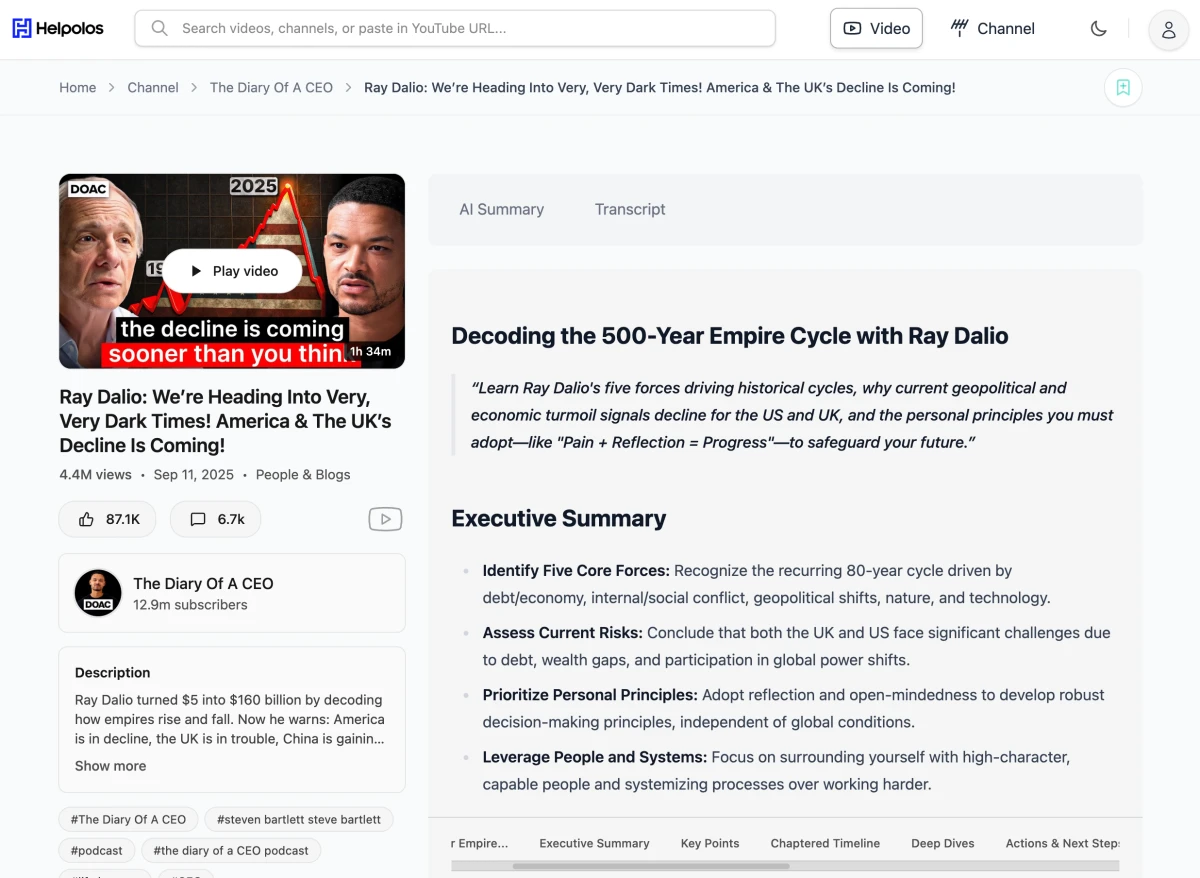
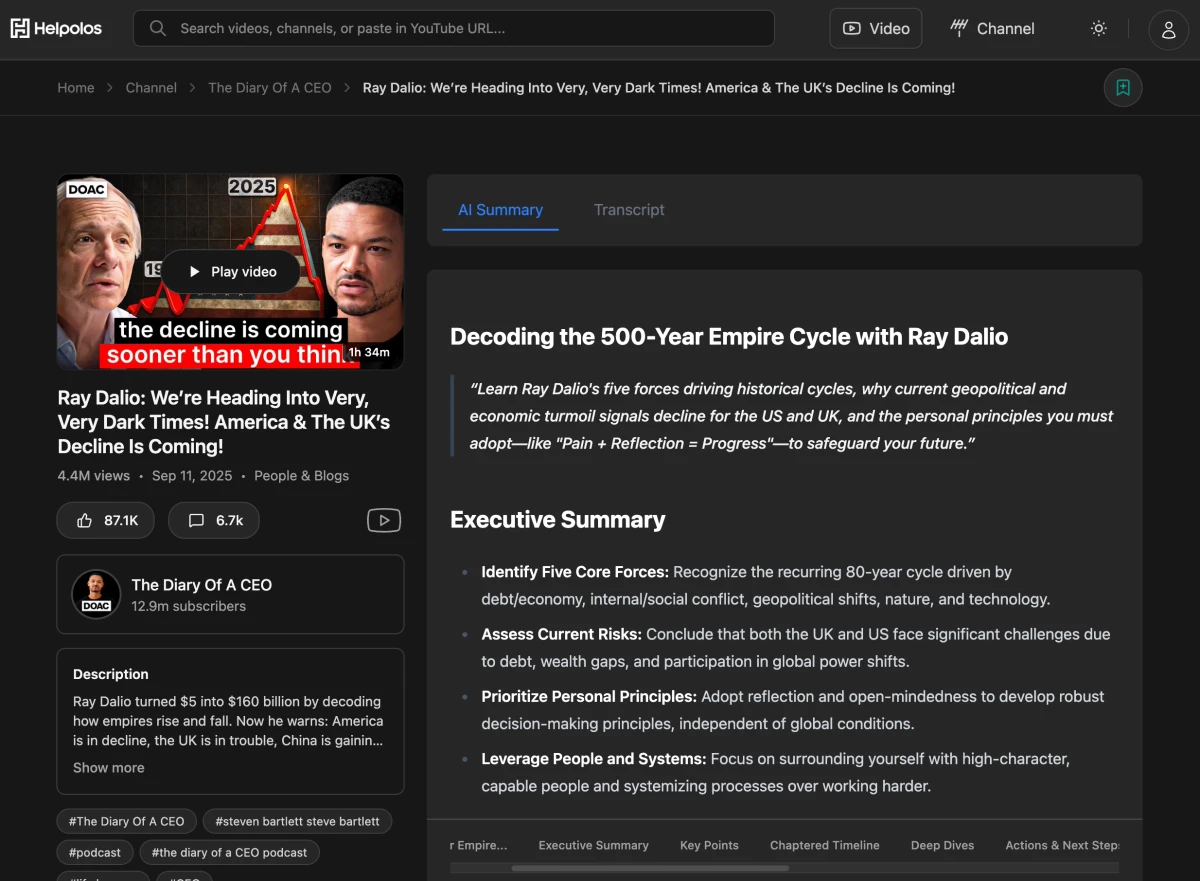
Helpolos takes any YouTube video and builds the infrastructure for you: AI-generated summaries showing what's covered and when, complete searchable transcripts with clickable timestamps, visual mind maps showing concept relationships, auto-generated quiz questions, and a chat feature students can use to clarify concepts.
Put simply: It converts raw video into structured learning materials.
The video becomes usable curriculum instead of just a link you email to students hoping they'll watch.
Why This Transforms Your Prep Time
Concrete outcomes for educators.
You evaluate videos in minutes, not hours. Is this documentary actually covering the Treaty of Versailles, or just mentioning it briefly? The summary tells you in 60 seconds what would take 60 minutes of watching to discover.
You create precise viewing assignments. "Watch from 14:32 to 22:15 and answer these questions." Students get focused learning. You get targeted assessment. No one wastes time on irrelevant content.
You get instant quiz questions. The AI generates comprehension questions based on actual video content. Edit as needed, but you're starting with a draft, not a blank page.
You support different learners. ESL students can read transcripts alongside video. Visual learners get mind maps. Students who missed class can search transcripts for specific topics. One video, multiple access points.
You build study guides automatically. Process your unit's videos once. The combined transcripts and summaries become a searchable study resource students can use for exam prep.
How This Fits Your Teaching Workflow
Realistic implementation for busy educators.
-
Find promising videos. YouTube search, TeacherTube, colleague recommendations—wherever you source video content.
-
Process before you preview. Run the video through Helpolos before you watch it yourself. The summary tells you if it's worth your full attention.
-
Check alignment. Does the summary match your learning objectives? Search the transcript for specific terms you need covered. Confirm the content fits before you build a lesson around it.
-
Create targeted assignments. Use timestamps to assign specific segments. Use the quiz questions as starting points for assessment.
-
Share supporting materials. Post the summary as a preview. Share the mind map as a study aid. Make the transcript available for accessibility.
-
Use chat for office hours. Students can ask the AI questions about the video content and get answers grounded in the transcript. It's like you being available 24/7, but automated.
Feature Deep Dive: Educator Tools
Searchable Transcripts with Timestamps
This changes how you use video in lessons. "At 12:47, the narrator explains the difference between mitosis and meiosis." You can reference specific moments in discussions. Students can find exact explanations when reviewing. The transcript is your video index.
Auto-Generated Quiz Questions
Not perfect, but a massive time-saver. The AI identifies key concepts and generates comprehension questions. You'll edit some, reject others, and keep many as-is. Starting from a draft beats starting from scratch every time.
Mind Maps for Concept Relationships
Videos are linear, but knowledge isn't. The mind map shows how "photosynthesis" connects to "chloroplast" connects to "glucose." Use it as a preview before the video, a summary after, or a study tool for exams.
Multi-Level Summaries
The brief summary tells you what the video covers. The detailed summary breaks down each section. Use the brief version to evaluate videos; use the detailed version as student study notes.
Student Chat Feature
When students watch asynchronously, they can't raise their hands. The chat feature lets them ask questions about the video content and get answers based on what was actually said. It's not replacing teacher expertise; it's extending video accessibility.
Educator Scenarios (Practical Applications)
Scenario 1: The Flipped Classroom Teacher
Mr. Rodriguez assigns one video per week for his AP Biology students to watch before class. Previously, students would show up with wildly different understandings of the content. Now he processes each video, shares the summary as a preview guide, and assigns the auto-generated quiz as proof of viewing. Class time focuses on application and questions because everyone arrives with baseline knowledge.
Scenario 2: The History Teacher Building a Unit
Ms. Chen is creating a unit on the Civil Rights Movement. She finds 8 documentaries that look relevant. Instead of spending 12+ hours watching them all, she processes each one, scans the summaries for which events and figures are covered, and builds her unit around the 3 documentaries that best match her objectives. Total evaluation time: 45 minutes.
Scenario 3: The Special Education Coordinator
Mr. Patel supports students with diverse learning needs. One student needs transcripts to follow along with audio content. Another needs the visual structure of mind maps. A third benefits from quiz questions for self-testing. Instead of creating three different support materials, he processes the video once and distributes appropriate resources to each student.
Scenario 4: The Department Chair Standardizing Resources
Dr. Williams leads a department of 12 teachers. She creates a shared database of processed videos organized by unit and standard. Any teacher can search transcripts across all departmental videos for specific concepts. New teachers have instant access to vetted, curriculum-aligned video resources with ready-made assessments.
Best Practices for Educational Use
Process before you assign. Never assign a video you haven't previewed. The summary makes previewing take 3 minutes instead of 60.
Create segment assignments. Long videos become manageable when you assign specific timestamp ranges. "Watch 0:00-15:00 for homework. We'll watch 15:00-25:00 together in class."
Share transcripts for accessibility. Students who need text support shouldn't have to ask for it. Post transcripts alongside video assignments by default.
Use quizzes diagnostically. The auto-generated questions tell you what the AI thinks is important. Compare that to what you think is important. The gaps are interesting for discussion.
Build over time. Every video you process adds to your curriculum library. This semester's prep work becomes next semester's ready-made resource.
Mistakes Educators Should Avoid
Assigning whole videos without guidance. Even with summaries available, students need direction. "Watch this video" is worse than "Watch this video and answer these three questions."
Skipping the alignment check. A great video on the wrong topic is still wrong for your class. Verify content alignment before building lesson plans.
Over-relying on auto-generated quizzes. The AI questions are starting points, not final products. Review and edit to match your assessment goals and rigor expectations.
Forgetting differentiation. You have multiple tools—transcripts, mind maps, summaries, quizzes. Different students benefit from different resources. Don't give everyone the same thing.
Not involving students. Older students can learn to process videos themselves. Teaching them to extract information efficiently is a skill that transfers beyond your classroom.
FAQ: Educators Using Helpolos
Does this work with videos my school hosts?
Helpolos works with YouTube videos specifically. If your school content is on YouTube (many educational institutions upload there), yes. For content on internal platforms, you'd need to check if YouTube versions exist.
How do I handle videos without accurate captions?
Helpolos relies on YouTube's captions (auto-generated or uploaded). Most educational content has decent captions. For videos with poor captions, the transcript quality will reflect that.
Can students use Helpolos directly?
Yes. Individual students can create free accounts. This is particularly powerful for teaching research skills—show students how to process and analyze video content themselves.
Is there a school or district plan?
Individual accounts get 10 free credits daily. For larger implementations, the API allows programmatic access. Contact Helpolos for institutional use cases.
What about copyright for educational use?
You're using publicly available YouTube content for educational purposes. The same fair use considerations that apply to showing videos in class apply to using processed transcripts and summaries. You're not republishing the content; you're creating educational materials based on it.
The Teaching Efficiency Equation
Every minute you spend finding and adapting video content is a minute you're not spending on direct instruction, student support, or (let's be honest) your own wellbeing.
The videos are out there. The curriculum potential is massive. The bottleneck is processing time.
Remove the bottleneck, and YouTube becomes what it should be for educators: an infinite library of curriculum materials, searchable and adaptable to your specific classroom needs.
Your students get better resources. You get your evenings back. That's the trade.
Unlock the Data Inside
Turn Videos into Knowledge
- Get FREE 10/day: transcripts, summaries, chats
- Chat with videos, export text & PDF
- $1 free API credit for RAG, chatbots & research
Free forever plan • All features unlocked