Research at Scale: How Researchers and Journalists Extract Intelligence from Video Evidence

Your investigation involves 30 hours of interview footage, expert testimony, and documentary evidence. All on YouTube. Your deadline is next week.
The traditional approach: watch everything, take meticulous notes, go back to find specific quotes, probably rewatch sections you've forgotten. That's 40+ hours of work minimum.
Here's the math that should make you uncomfortable: You'll spend more time watching content than analyzing it.
There's a better way.
The Video Research Bottleneck
Video has become primary source material across disciplines. Expert interviews on YouTube. Conference presentations documenting research. Government hearings and public testimonies. TED Talks presenting new findings. Investigative subjects with extensive video footprints.
But video is research-hostile by design. You can't skim it. You can't Ctrl+F it. You can't quickly compare two segments side by side. Every minute of content requires a minute of attention.
Think of it like having a massive document archive, except every document is locked in audio format with no search function and no table of contents. You have to read every word out loud to find what you need.
For a single video, this is manageable. For the dozens or hundreds of videos that serious research requires, it's a bottleneck that delays projects and limits thoroughness.
What Helpolos Does for Researchers
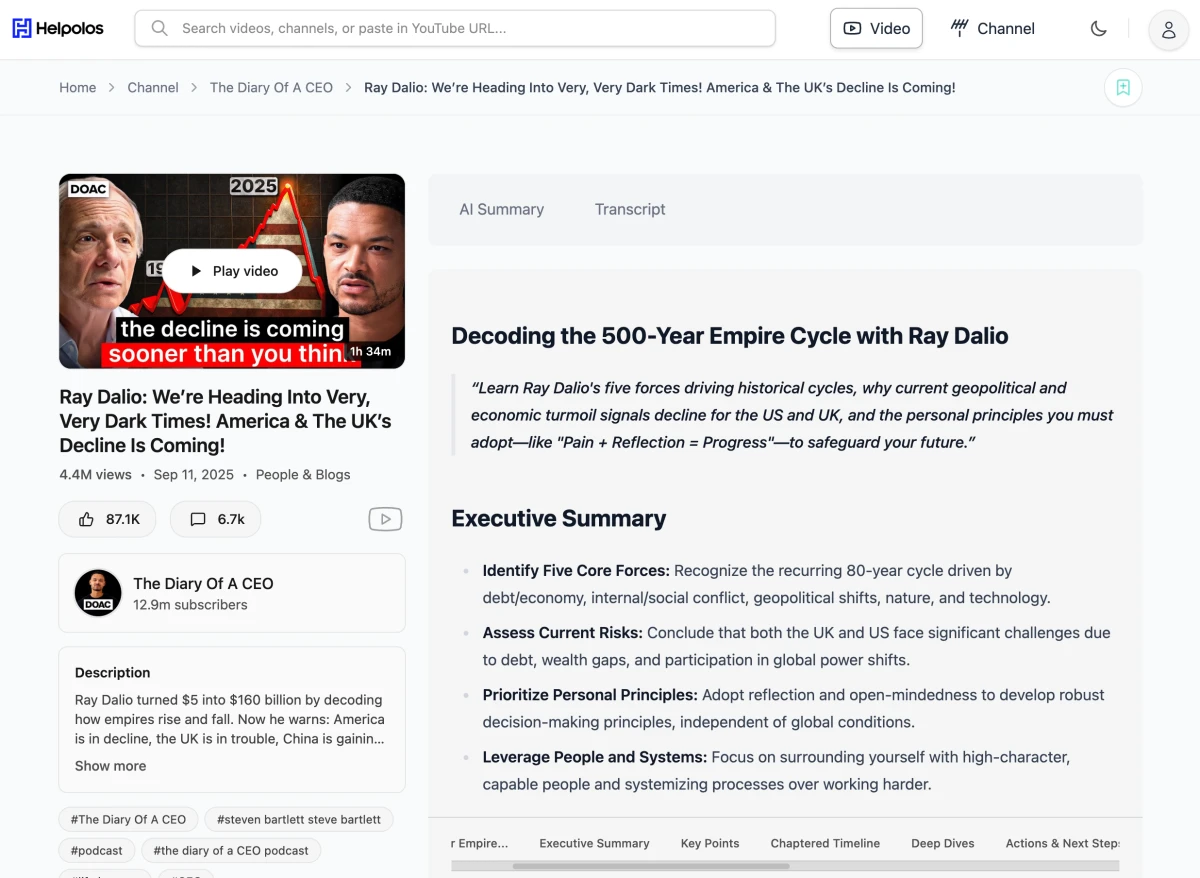
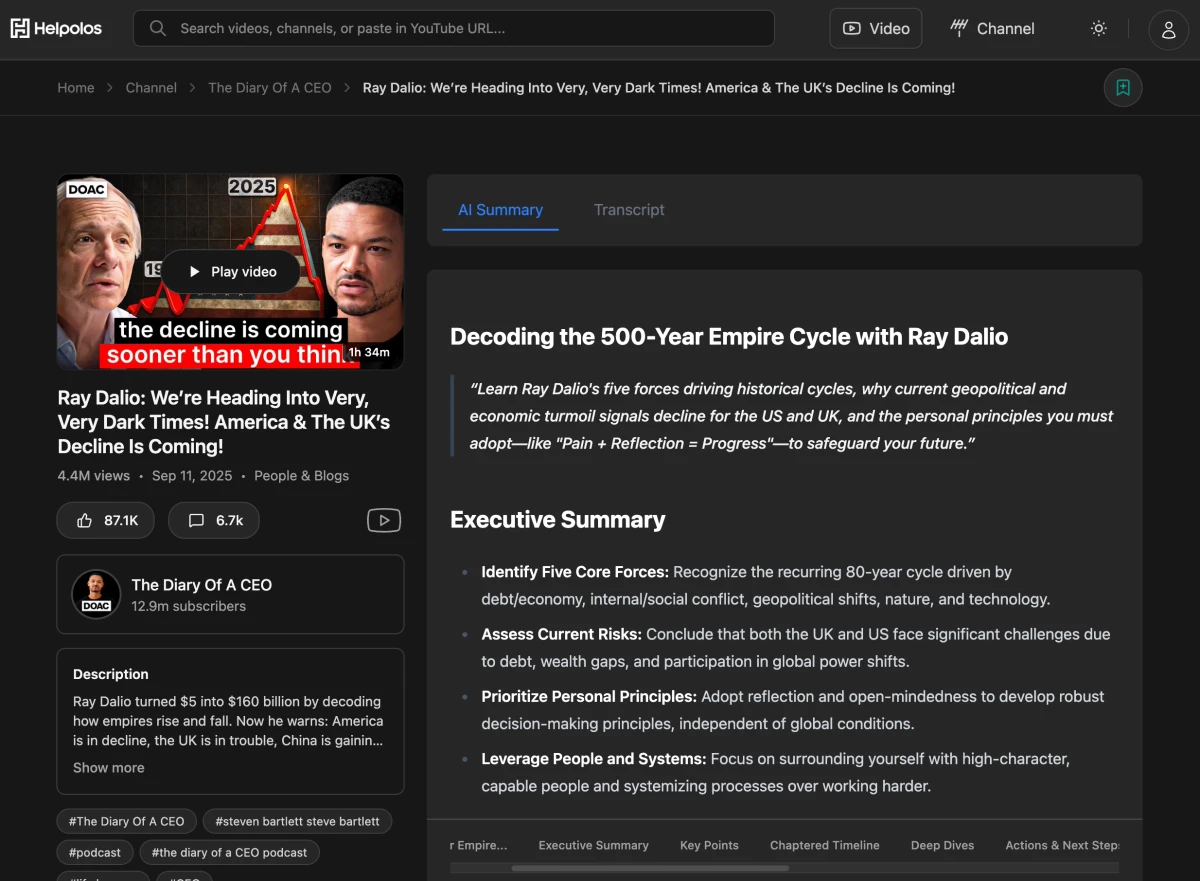
Helpolos transforms any YouTube video into searchable, analyzable data: complete timestamped transcripts, AI-generated summaries of key points, visual mind maps showing concept relationships, and a chat feature that answers specific questions with transcript citations.
Put simply: It makes video evidence as searchable as text documents.
Your video archive becomes a queryable database.
Why This Changes Research Methodology
Concrete improvements to your research process.
You search 30 hours of video in 5 seconds. Process your source videos once. Then search across all transcripts for any term. Every mention of "policy failure" or "budget shortfall" or your subject's name—instantly located with timestamps.
You never miss a mention. Manual video review means sampling. You watch hoping to catch relevant sections. Transcript search means comprehensive coverage. You find every instance, not just the ones you happened to catch.
You verify quotes accurately. The transcript gives you exact words. The timestamp lets you confirm context. When you cite a source, you're citing precisely, not from memory or paraphrase.
You build comparative analyses faster. How do different experts address the same topic? Process their videos. Search each for the same terms. Compare positions systematically instead of relying on impressions from sequential viewing.
You trace claims to sources. Video makes bold claims. "Studies show..." The chat feature can identify what study, what findings, what caveats were mentioned. Then you verify independently.
The Research Workflow, Upgraded
How this fits rigorous methodology.
-
Compile source videos. Expert interviews, conference talks, testimonies, documentaries—whatever YouTube content is relevant to your research.
-
Process in batches. Paste URLs into Helpolos. Each video takes under a minute to process. A library of 50 videos takes an afternoon, not a week.
-
Scan summaries for relevance. Which videos actually contain what you need? Eliminate irrelevant sources before you invest time.
-
Search transcripts systematically. Your research questions become search queries. "Carbon pricing," "election interference," "funding mechanism"—search across your entire video corpus.
-
Extract and cite. Copy exact quotes with timestamps. Build your citation database. Reference specific moments that others can verify.
-
Ask targeted questions. Use the chat feature to query specific videos. "What evidence did they present for their claim about declining enrollment?" Get answers grounded in the transcript.
-
Verify everything. The transcript reflects what was said. Whether what was said is accurate requires your verification. Click timestamps to confirm context for critical citations.
Feature Deep Dive: Research Tools
Cross-Transcript Search
The most powerful research feature. You've processed 20 interviews with experts on housing policy. Search "rent control" across all of them. Every mention, every timestamp, every context—instantly. That search would take 40+ hours of manual viewing.
Timestamped Citation
Academic rigor requires precise citation. "Smith, 2023, 34:17" is verifiable. Anyone can click the timestamp and confirm your quotation. Your research becomes auditable at the sentence level.
Comparative Analysis via Summaries
Process multiple videos on the same topic. Compare summaries side-by-side. What does Expert A emphasize that Expert B ignores? Where do they agree? Where do they contradict? The summaries make this comparison feasible.
Chat for Targeted Queries
"What methodology did they describe for measuring sentiment?" The chat extracts the specific answer from the transcript. You're not asking the AI to invent information; you're asking it to find information that exists in the video.
Mind Maps for Complex Topics
Long-form interviews and lectures cover many interconnected topics. The mind map shows how the speaker connected ideas. Useful for understanding argument structure and identifying logical relationships.
Research Scenarios (Methodological Applications)
Scenario 1: The Academic Researcher
Dr. Martinez is writing a paper on tech industry lobbying. She has identified 40 YouTube videos of congressional hearings, industry presentations, and expert interviews. Manual review would take two weeks. She processes all 40, searches transcripts for "Section 230," "content moderation," and "platform liability," and builds a comprehensive source matrix in two days. Her literature review cites specific testimony with exact timestamps. Peer reviewers can verify every claim.
Scenario 2: The Investigative Journalist
James is investigating a public figure's changing statements on environmental policy. The subject has given 35+ interviews over five years. Instead of watching 50+ hours hoping to catch contradictions, James processes everything and searches for "climate," "regulation," and "emissions" across all transcripts. He builds a timeline of statements with exact quotes and dates. His story is bulletproof because every claim links to timestamped evidence.
Scenario 3: The Doctoral Student
Aisha is conducting qualitative research on how entrepreneurs discuss failure. Her data set includes 60 founder interviews on YouTube. Manual coding would take months. She processes all videos, searches for "failure," "pivot," "mistake," and related terms, and exports segments for qualitative analysis software. Her coding is systematic and comprehensive. Her dissertation committee is impressed by her rigor.
Scenario 4: The Policy Analyst
The think tank needs a report on expert opinion regarding AI regulation. There are 25 relevant conference talks and panel discussions. The analyst processes everything, compares how different experts frame the same issues, and identifies consensus vs. controversy. The report includes a methodology section explaining the systematic video analysis. Stakeholders trust the comprehensiveness.
Best Practices for Rigorous Research
Document your search methodology. Keep records of what you searched, across which videos, and what you found. Your methodology should be reproducible.
Always verify against original. The transcript is accurate to what YouTube's captions say. YouTube's captions are usually but not always accurate to what was spoken. For critical quotes, verify by watching the timestamped segment.
Triangulate claims. If one video makes a factual claim, search other videos for corroboration or contradiction. Video content can be as biased as any other source.
Note context carefully. A quote at 34:17 makes sense in the context of what was said at 33:45. When you cite, consider whether context matters for interpretation.
Use the API for large-scale analysis. If you're processing hundreds of videos, the API lets you automate. Build pipelines that process new content automatically.
Mistakes Researchers Should Avoid
Trusting transcripts blindly. Auto-generated captions have errors. Technical terms, names, and numbers are especially prone to mistakes. Verify anything you'll publish.
Searching too narrowly. Your search terms might miss relevant content phrased differently. Use multiple related queries. "Climate change," "global warming," "environmental crisis" might appear in different videos discussing the same phenomenon.
Ignoring negative results. The absence of a search term is also data. If an expert never mentions a common counterargument, that's potentially significant.
Over-extracting from context. The transcript makes it easy to pull quotes. The responsibility to represent context fairly is still yours. Don't quote-mine.
Not securing your sources. YouTube videos can be deleted or made private. For critical sources, consider archival strategies beyond relying on continued YouTube availability.
FAQ: Research Use
How reliable are auto-generated transcripts?
YouTube's auto-generation is good but imperfect. Common words are usually accurate. Names, technical jargon, and numbers require verification. For critical citations, always confirm by watching the timestamped segment.
Can I cite Helpolos transcripts in academic work?
You cite the original video, not the transcript tool. "Smith, J. (2023). Interview on Climate Policy [Video]. YouTube. https://... (34:17)" The transcript is your research aid; the video is your source.
What about non-English videos?
Helpolos returns transcripts in the original language. It doesn't translate. If your research requires non-English sources, you need language competency or translation support.
How do I handle very long videos?
Long videos (hearings, conferences) work the same way. The transcript is longer, but searching it is still instant. For multi-hour content, the summary is especially valuable for orientation.
Is there an API for bulk processing?
Yes. The API allows programmatic access for researchers processing large video corpora. Start with 500 free transcript requests to test your methodology.
The Research Advantage
Thorough research requires comprehensive source coverage. In a video-dominated information environment, comprehensive means watching everything relevant.
Nobody has time to watch everything. So researchers sample. They watch what they can and hope they caught what matters.
Transcript search changes that equation. You can search everything. You can find every mention across your entire source corpus. Your coverage becomes comprehensive in a way that manual viewing never allows.
That's not just efficiency. That's methodological improvement.
Your competitors are still watching videos at 1x speed, hoping to catch what matters. You're searching systematically across everything that exists.
Unlock the Data Inside
Turn Videos into Knowledge
- Get FREE 10/day: transcripts, summaries, chats
- Chat with videos, export text & PDF
- $1 free API credit for RAG, chatbots & research
Free forever plan • All features unlocked