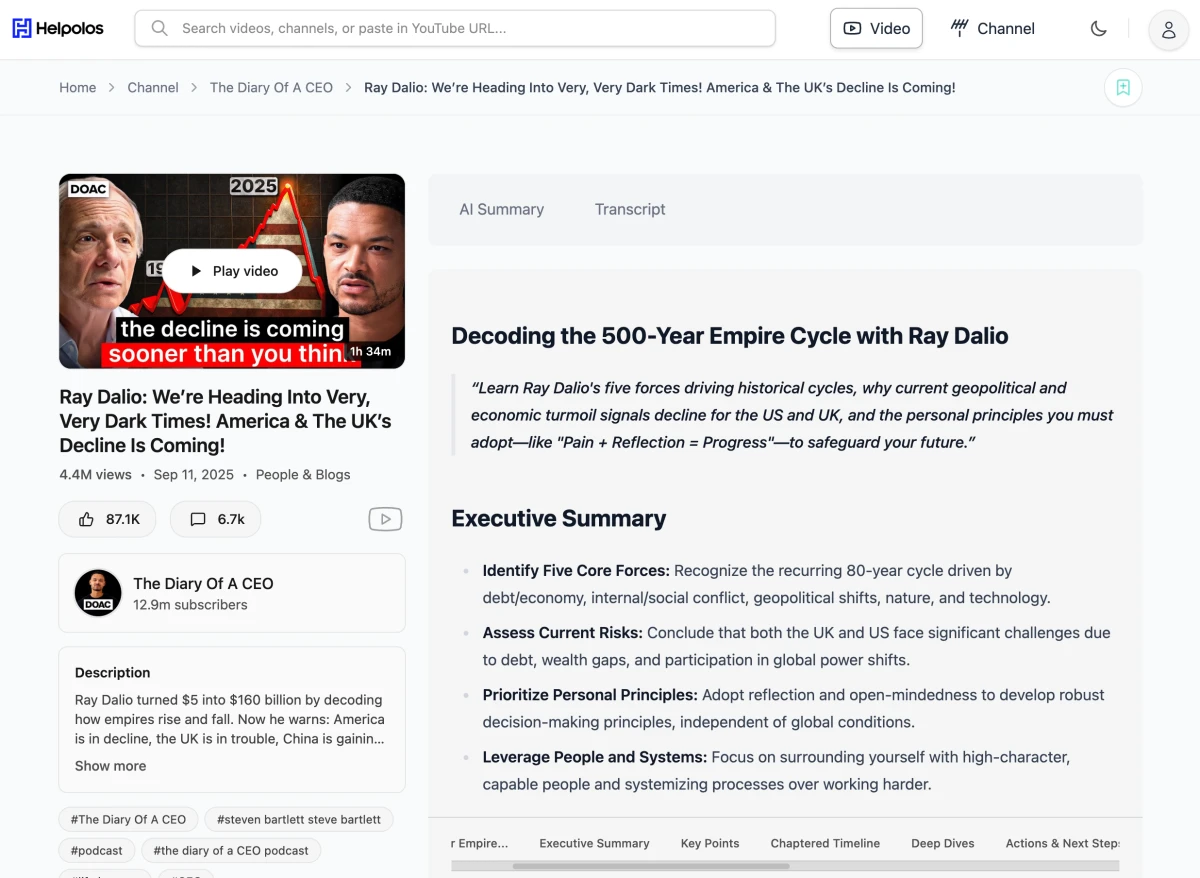
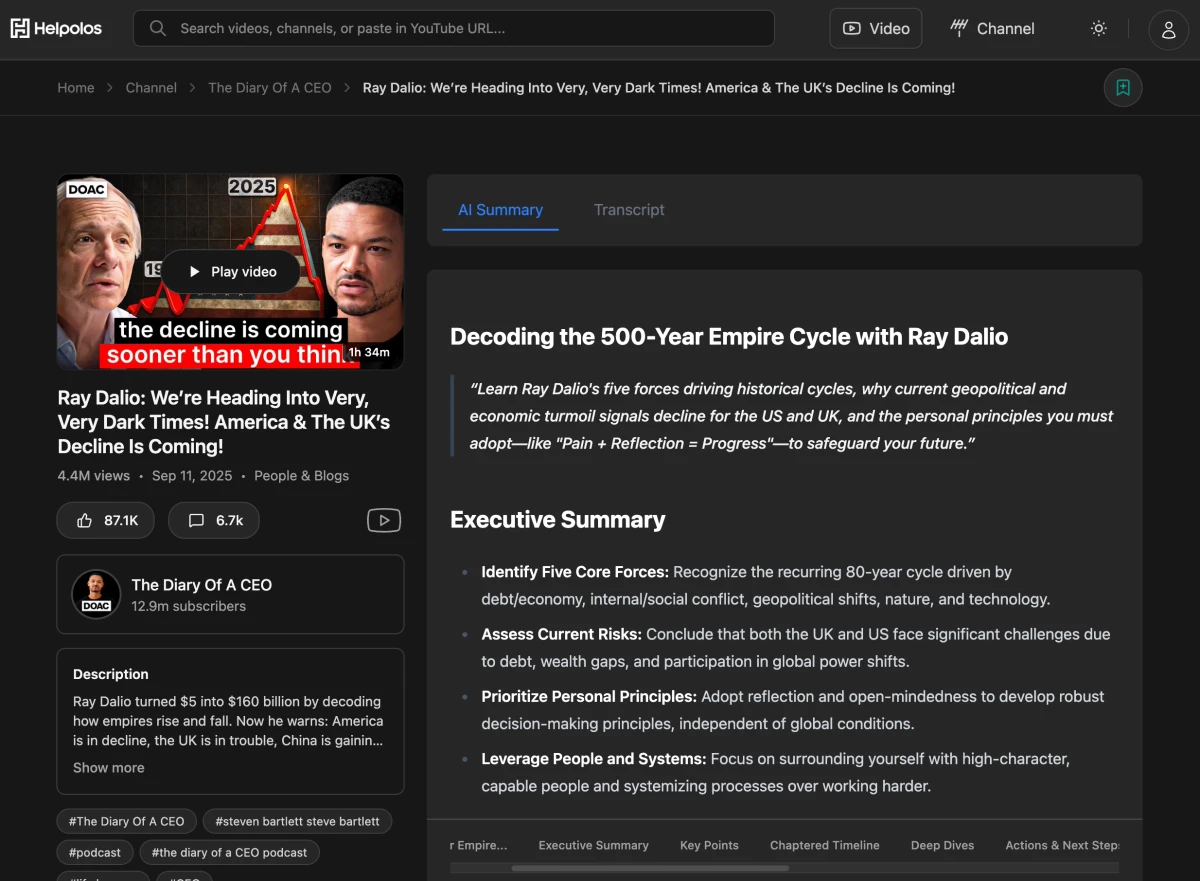
How Students Can Stop Watching and Start Learning: A Complete Guide to Helpolos

You've got three papers due, a midterm next week, and a backlog of lecture recordings that would take 47 hours to watch. (Yes, you counted. Twice.) Here's the thing: traditional video learning is broken for students. You need information fast, but professors ramble. You need key concepts clear, but YouTubers repeat themselves for the algorithm.
What if you could extract pure knowledge from any video in minutes?
This isn't about cutting corners. It's about studying strategically.
The Real Problem with Video Learning in College
Think of it like mining for gold with a spoon. Sure, you'll eventually find what you need, but at what cost? Every hour you spend watching a 60-minute lecture that contains maybe 12 minutes of actual testable content is an hour you could have spent practicing problems, writing your paper, or sleeping.
Most educational videos follow the 80/20 rule: 80% filler, 20% substance. That filler isn't useless—it builds context and keeps viewers engaged. But when you're cramming for an organic chemistry final at 2 AM, you don't need the professor's stories about their graduate school days. You need the reaction mechanisms, definitions, and example problems.
Here's what that looks like in practice: You're researching for a history paper on the Cold War. You find a brilliant three-hour documentary. Buried in there are exactly three quotes you need and one key insight about Soviet economic policy. But you have to watch the entire thing to find them. Or do you?
What Helpolos Actually Does for Students
Helpolos takes any YouTube video and gives you five tools: AI summaries, searchable transcripts, interactive mind maps, quizzes to test retention, and a chat feature that lets you ask specific questions about the content.
Put simply: It turns passive video consumption into active knowledge extraction.
Instead of watching, you're mining. And you've got industrial equipment instead of a spoon.
Why This Matters for Your Grades (and Your Sanity)
Not vague "improve your learning" fluff. Real, tangible outcomes.
You cut study time dramatically. A 60-minute lecture becomes a 5-minute read. A two-hour documentary becomes a 10-minute scan. That's what happens when you remove pauses, tangents, and repetition.
You retain information better. Reading a summary while viewing a mind map engages multiple memory pathways. The quiz feature forces active recall—research shows this is one of the most effective study techniques available.
You find facts instantly. Writing a paper and need to cite a specific statistic? Search the transcript. Need the exact minute a concept was introduced? Click the timestamp. No more scrubbing through videos hoping you land in the right spot.
You stop zoning out. We've all been there—20 minutes into a lecture video and you realize you haven't absorbed a word since the example about ionic bonds. With Helpolos, you process content at your own reading speed, which is typically 2-3x faster than listening speed.
You actually understand complex topics. Mind maps show relationships between concepts. The chat feature lets you ask "Can you explain this differently?" without the embarrassment of raising your hand in a 300-person lecture hall.
How It Fits Into Your Actual Study Workflow
This isn't another tool that demands you change how you work. It slides into your existing routine and makes every step faster.
Find your video. Lecture recording, Khan Academy explanation, documentary, TED Talk—whatever you need.
Paste the URL into Helpolos. That's it. No extensions to install, no software to download.
Get your analysis in under a minute. The AI processes the entire video, extracting transcripts, generating summaries, and building your study tools.
Start with the summary. Read the condensed version first. This tells you whether the video even contains what you need. (Huge time-saver right there.)
Dive deeper where it matters. Need to understand one concept better? Read that section of the transcript. Need to see how ideas connect? Pull up the mind map.
Test yourself. Use the quiz feature to identify what you missed. Then go back to the exact timestamp in the transcript to review.
Ask questions. Stuck on a concept? The chat feature gives you grounded answers based only on the video content. No hallucinations, no made-up facts.
Feature Deep Dive: What Students Use Most
Multi-Level Summaries The AI creates a bullet-point overview, then nested details. Think of it like an outline you'd make for a textbook chapter, except it's instant and doesn't require you to pause the video every 30 seconds.
Searchable Transcripts with Timestamps This might be the most powerful feature for research papers. You can search for "Keynesian economics" or "mitochondria" and jump straight to every mention. Each result includes a clickable timestamp that opens the video at that exact moment.
Mind Maps for Visual Learners Your brain doesn't store information in linear lists. It stores it in networks. Mind maps show you how "cellular respiration" connects to "ATP" connects to "mitochondria." For visual learners, this changes everything about how you process lecture content.
Quizzes That Actually Test Understanding Most auto-generated quizzes are garbage. They test whether you remember the exact wording, not whether you understand the concept. Helpolos quizzes ask you to apply what you learned, not just parrot it back.
Chat for Clarification Without the Wait Can't ask a recorded professor to clarify. But you can ask Helpolos. "What did they mean by positive feedback loop?" Get an answer grounded in the transcript, with a timestamp to hear it yourself.
Real Student Scenarios (With Actual Workflows)
Scenario 1: The Cramming Senior It's finals week. You have 12 lecture recordings from your Advanced Statistics class. Each is 90 minutes. You could watch 18 hours of video. Or you could run them all through Helpolos, read the summaries (60 minutes total), take the quizzes to find your weak spots, and use the chat to clarify the Poisson distribution concept you never quite got. Total time: 3 hours. Sleep acquired: 5 hours more than your classmates.
Scenario 2: The Research Paper Archaeologist You're writing a 20-page paper on climate policy. You find a two-hour Senate hearing, a 45-minute interview with an IPCC scientist, and three TED Talks on carbon capture. You need specific quotes, data points, and policy proposals. Instead of watching 5+ hours of content, you generate transcripts, search for "carbon tax," "Paris Agreement," and "2030 targets," and extract exactly what you need in under an hour. Your bibliography is precise, your quotes are accurate, and you didn't spend half a day listening to political posturing.
Scenario 3: The Confused Freshman Organic chemistry is breaking your brain. You found a YouTube channel that explains mechanisms beautifully, but the videos are 30 minutes each and cover way more than your syllabus. You use Helpolos to get summaries of relevant videos, mind maps to see how reactions relate, and the quiz feature to practice. When you get confused about why a particular carbocation forms, you chat with the video to get a transcript-grounded explanation. You pass the exam. You don't switch majors.
Best Practices: Getting the Most from Helpolos
Start with the quiz. This sounds backwards, but taking the quiz before you read the summary tells you what the AI thinks is important. It's like looking at the study guide before reading the textbook.
Use mind maps for essay planning. When you need to write a paper, the mind map shows you how concepts connect. Those connections become your topic sentences and argument structure.
Batch process lecture recordings. Every Monday, dump all your week's lecture URLs into Helpolos. Takes 5 minutes. Then you have searchable, quiz-able study materials for the entire semester.
Cite the timestamps. When writing papers, use the clickable timestamps as citations. Your professors can verify your sources in seconds. It makes you look incredibly thorough.
Chat with purpose. Don't ask vague questions like "What is this about?" Ask specific questions like "What is the definition of osmosis given in this video?" Specific questions get specific answers with specific timestamps.
Mistakes Students Make (And How to Avoid Them)
Treating summaries as substitutes. The summary is your starting point, not your ending point. Use it to decide if the video is worth deeper investigation. Don't skip the deep investigation.
Ignoring the transcript. The summary gives you what the AI thinks matters. The transcript gives you everything. When writing papers, "everything" is often what you need.
Not using free credits strategically. You get 10 free credits daily. That's 10 full analyses or 10 chat messages. Don't waste them on random videos. Save them for content that actually impacts your GPA.
Forgetting to verify. The AI is powerful but not infallible. When you find a critical quote or statistic, click the timestamp and verify it in the original video. Takes 10 seconds and saves you from citation errors.
Using it only for cramming. Helpolos is most powerful when used throughout the semester. Process lectures weekly. Build your knowledge base gradually. Cramming works, but distributed practice works better.
FAQ: Studying with Helpolos
How is this different from just watching at 2x speed? Speed-watching is like speed-eating. You might consume it faster, but you don't digest it better. Helpolos changes the format entirely—from passive audio to active text. You can skim, search, and interact with the content. Plus, your comprehension doesn't drop as it does with sped-up audio.
Can I use this for any YouTube video? As long as the video has captions (auto-generated or manual), yes. That covers virtually all educational content, most documentaries, and a huge percentage of general videos. If a video has no captions, Helpolos can't process it.
What if I need more than 10 credits per day? The free tier is genuinely free—no credit card needed. But if you're processing multiple long lectures or having extensive chat sessions, the premium plan gives you 100 daily credits. For most students, the free tier covers daily study needs.
Will my professors think this is cheating? You're still doing the work of learning. You're just doing it more efficiently. Helpolos doesn't replace your brain; it removes the time barrier between you and the information. Think of it like using a calculator for calculus—you still need to understand the concepts.
How accurate are the summaries? The AI extracts main points and supporting details directly from the transcript. For well-structured educational videos, accuracy is extremely high. Always verify critical details using the timestamps.
Ready to Actually Learn Instead of Just Watch?
You've got enough on your plate. Stop spending 60 minutes to get 12 minutes of useful information. Start extracting knowledge on your terms, at your speed, in formats that match how you actually learn.
Try Helpolos free. No credit card. No installation. Just paste a URL and watch your study time shrink while your comprehension grows.
Unlock the Data Inside
Turn Videos into Knowledge
- Get FREE 10/day: transcripts, summaries, chats
- Chat with videos, export text & PDF
- $1 free API credit for RAG, chatbots & research
Free forever plan • All features unlocked