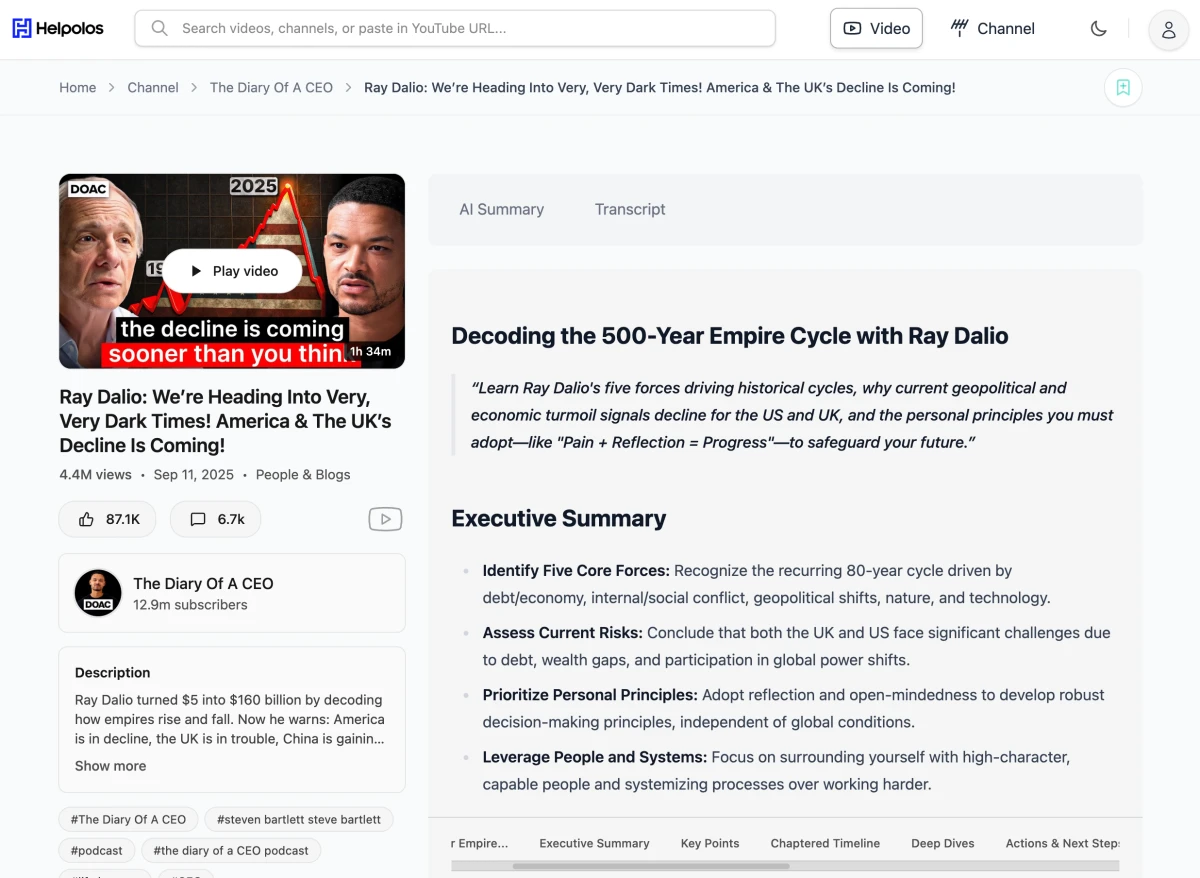
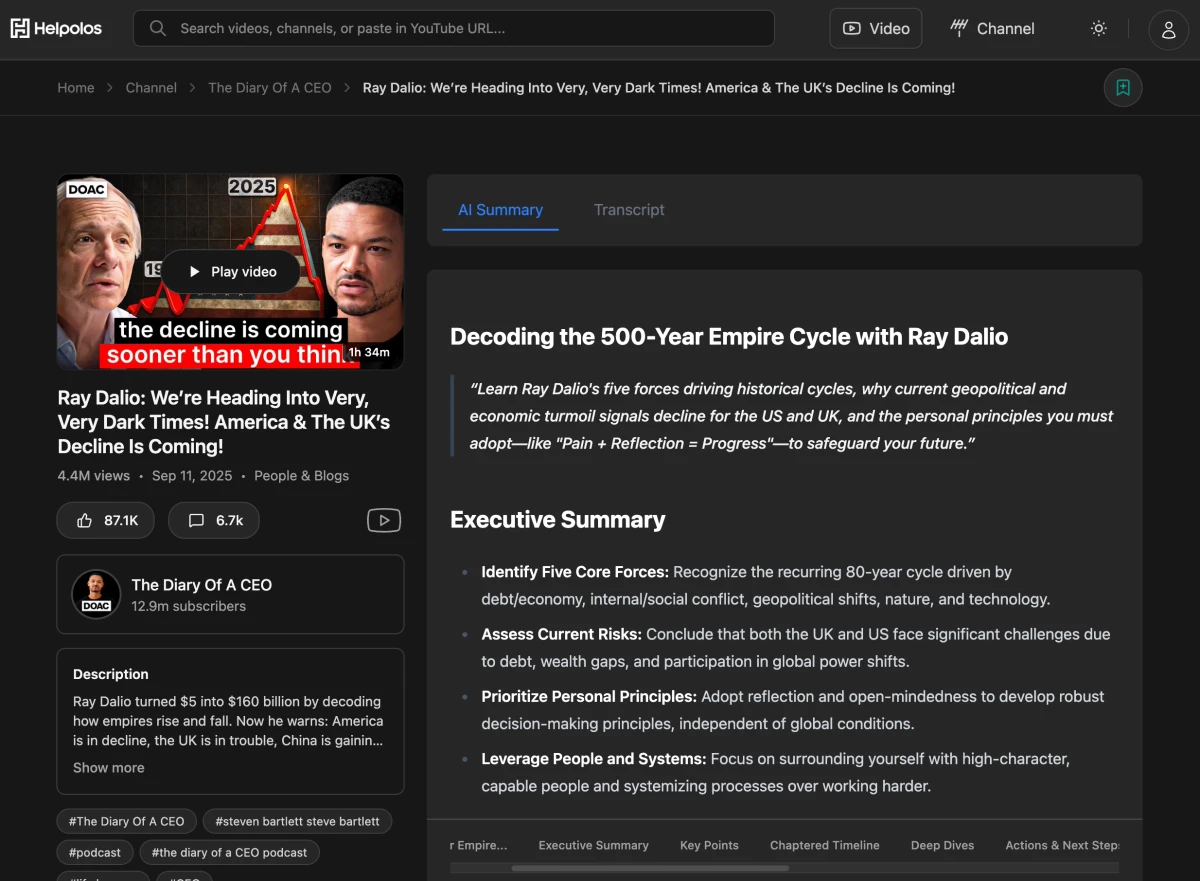
Learn Anything from YouTube Without Wasting Your Evenings

You sit down to learn something new. Photography, maybe. Or how to fix that leaky faucet. Or finally understanding how the stock market works. Two hours later, you've watched a bunch of videos but can't actually remember what you learned.
Sound familiar?
Here's the uncomfortable truth: You didn't learn. You watched. Those aren't the same thing.
Why YouTube Learning Usually Fails
YouTube is an incredible learning resource. Free expert instruction on virtually any topic. The world's best teachers, available whenever you want.
But here's the problem: watching isn't learning.
Your brain zones out. You're 20 minutes into a tutorial and suddenly realize you haven't absorbed anything since the explanation of aperture settings. You rewind. You zone out again. The cycle repeats.
You can't find things later. "That video explained it perfectly, but where?" It's buried somewhere in a 45-minute tutorial you can't search through.
There's no structure. Videos jump around. Different creators explain things differently. You watch several videos on the same topic but can't organize what you've learned into usable knowledge.
You never test yourself. You think you understand, then try to actually do the thing and realize you retained nothing. The video gave you the illusion of learning without the actual learning.
This isn't a character flaw. It's how video consumption works. The solution isn't trying harder. It's changing the approach.
What Helpolos Does for Personal Learning
Helpolos takes any YouTube video and transforms it into actual learning materials: AI summaries capturing key points, searchable transcripts with clickable timestamps, visual mind maps showing how concepts connect, quiz questions to test your understanding, and a chat feature for clarification.
Put simply: It turns passive video consumption into active knowledge acquisition.
The video becomes a resource you can study, not just content you consume.
Why This Actually Helps You Learn
Real benefits, not marketing speak.
You preview before committing. The summary tells you what a video covers in 2 minutes. Is this the right tutorial for what you need? Decide before you invest 45 minutes finding out the hard way.
You find specific information instantly. "How long should I let the dough rise?" Search the transcript. Jump to exactly that moment. No scrubbing through 30 minutes of baking tutorial.
You see how things connect. Mind maps show relationships between concepts. "ISO" connects to "exposure" connects to "aperture" connects to "light." Visual learners understand concepts faster through these spatial relationships.
You actually test yourself. Studies show self-testing dramatically improves retention compared to just re-watching. The quiz feature does this automatically from the video content.
You can ask questions. Confused about something the video mentioned? Ask the chat. Get an answer based on what was actually said, with a timestamp to review the original explanation.
How Personal Learning Actually Works
Your YouTube learning, upgraded.
-
Find your video. Tutorial, documentary, lecture, how-to guide—whatever you're trying to learn.
-
Process it first. Paste the URL into Helpolos before you watch anything. Takes 30 seconds.
-
Read the summary. Is this video actually covering what you need? At what depth? Decide if it deserves your time.
-
Watch with purpose. Now when you watch, you know what's coming. You can focus on understanding instead of wondering "is this relevant?"
-
Use the transcript for review. When you need to remember something specific, search the transcript. It's your personalized reference guide.
-
Test yourself. Take the quiz. Identify what you actually retained vs. what you just think you retained. The gaps tell you what to review.
-
Ask clarifying questions. Use the chat when something doesn't click. Get answers grounded in what the video actually explained.
Feature Deep Dive: Personal Learning Tools
Searchable Transcripts
This changes everything for practical skills. Watching a home repair tutorial? You're not going to remember every step while you're standing in your bathroom with a wrench. Search the transcript for "shut off valve" when you need it. It's an instant reference guide for anything you've learned.
Mind Maps for Complex Topics
Some topics have lots of interconnected concepts. Finance. Photography. Music theory. The mind map shows how ideas relate to each other. That visual structure helps concepts stick in ways that linear video can't.
Quizzes for Honest Self-Assessment
You think you understood the video. Did you really? The quiz finds out. Getting questions wrong isn't failure—it's feedback showing you exactly what to review. Much better to discover gaps now than when you're actually trying to use the skill.
Chat for Clarification
The video moved fast and you're confused about one thing. "What's the difference between compound interest and simple interest?" The chat answers based on what the video explained, with a timestamp to review the original explanation if you need more detail.
Summaries for Decision-Making
Before investing an hour in a tutorial, know what you're getting. The summary tells you scope, depth, and approach. Choose videos that actually match what you need to learn.
Personal Learning Scenarios
Scenario 1: The Weekend Woodworker
Mike wants to build a bookshelf. He finds 5 tutorial videos, ranging from 15 minutes to 2 hours. Instead of watching all 5 hours of content, he processes each one and reads the summaries. Two videos cover exactly what he needs. He watches those, and uses the transcripts as reference guides while actually building. When he forgets the right angle for the pocket hole jig, he searches "pocket hole" and gets the answer in 3 seconds.
Scenario 2: The Finance Learner
Sarah wants to understand investing basics. She's watched several videos but everything's jumbled in her head. She processes the best explanations she found, uses the mind maps to see how concepts connect, and takes the quizzes to identify her weak spots. When she doesn't understand "expense ratios," she asks the chat for clarification. After two hours of structured learning (instead of six hours of confused watching), she actually understands how to evaluate an index fund.
Scenario 3: The Home Chef
David is learning to make bread. He has a favorite tutorial but can never remember the specific timing. He processes the video once. Now he has a searchable transcript that serves as his recipe reference. "How long to proof?" Search it. "What temperature?" Search it. The 45-minute video becomes an instant reference guide he can access while his hands are covered in flour.
Scenario 4: The Language Learner
Mei is learning Spanish through YouTube videos. She processes her lesson videos, uses the transcripts to read along with audio (great for comprehension), and uses the quiz feature to test vocabulary retention. When she encounters a grammar point she doesn't understand, she searches previous transcripts to see how it was explained before. Her learning has structure instead of chaos.
Best Practices for Personal Learning
Take the quiz first. Before reading the summary, take the quiz. It shows you what's considered important and reveals what you need to focus on when you do engage with the content.
Build a personal reference library. Save transcripts from the best tutorials on topics you care about. That woodworking video you loved? Its transcript is now your searchable woodworking reference.
Use mind maps for retention. After watching something complex, look at the mind map. The visual relationships help you remember how concepts connect. It's a form of active review.
Search before rewatching. Need to remember something from a video you watched last month? Search the transcript first. You probably don't need to rewatch—you just need the specific information.
Test honestly. The quiz isn't about getting 100%. It's about discovering what you don't know. A question you get wrong is more valuable than a question you get right—it tells you exactly what to study.
Mistakes Personal Learners Make
Treating summaries as shortcuts. The summary is a preview and review tool, not a replacement for actual learning. You still need to engage with the content; the summary just makes that engagement more efficient.
Not returning to transcripts. You processed a video, learned from it, and... forgot about the transcript. That transcript is a permanent reference. Use it when you need to remember specifics.
Skipping quizzes because they feel "academic." The quiz is your honest feedback mechanism. Skipping it means you don't know what you actually learned vs. what you think you learned.
Learning without doing. Helpolos makes learning from videos more efficient. But learning a skill still requires practice. Don't just consume better—actually apply what you learn.
Processing everything. Not every video needs full analysis. A 3-minute tip? Just watch it. A 45-minute comprehensive tutorial? Process it.
FAQ: Personal Learning
Does this work for any YouTube video?
As long as the video has captions (auto-generated or uploaded), yes. Most videos have captions. If a video has no captions, Helpolos can't process it.
Is this cheating at learning?
You're still doing the learning. You're just doing it more efficiently. The knowledge still has to go into your brain. Helpolos removes the friction, not the work.
What if I learn better by watching than reading?
Then watch! Helpolos doesn't replace watching—it supplements it. Watch with the summary in mind. Use the transcript for review afterward. Use the quiz to test retention. The video is still part of your learning process.
How does this help retention?
Multiple formats (video + text + visual map + quiz) engage different cognitive pathways. Active recall through quizzes is particularly powerful for long-term retention. You're not just passively absorbing; you're actively processing.
I barely have time to watch videos. How does this help?
It helps by letting you extract value from videos without watching every minute. Read summaries to get key points. Search transcripts for specific answers. You get more learning per minute of your time.
Learning vs. Watching
There's a difference between consuming content and acquiring knowledge. YouTube makes consumption effortless. Open the app, hit play, let the algorithm guide you. Three hours vanish. What did you learn? Hard to say.
Actual learning requires structure. What are you trying to learn? What are the key concepts? Do you understand them? Can you recall them later? Can you apply them?
Helpolos provides that structure. It doesn't make learning automatic. It makes intentional learning more practical.
The videos are the same. The knowledge is there. The question is whether it ends up in your head in a way you can actually use.
You already spend time watching YouTube. You might as well remember what you watch.
Unlock the Data Inside
Turn Videos into Knowledge
- Get FREE 10/day: transcripts, summaries, chats
- Chat with videos, export text & PDF
- $1 free API credit for RAG, chatbots & research
Free forever plan • All features unlocked