Build Anything With a CUSTOM MCP Server - Python Tutorial

Related videos

Build & Deploy a Python AI Agent in 20 Minutes
Tech With Tim
38.6k views

Build a Python AI Agent in 10 Minutes
Tech With Tim
84.2k views

How to Build AI Agents in Python
Tech With Tim
46.7k views

How to Build a Production-Ready RAG AI Agent in Python (Step-by-Step)
Tech With Tim
77.8k views

Python is Changing – Here’s What’s Coming
Tech With Tim
165.5k views

The Next Step After Learning Python Basics
Tech With Tim
107.8k views

Learn Pandas in 30 Minutes - Python Pandas Tutorial
Tech With Tim
166.6k views
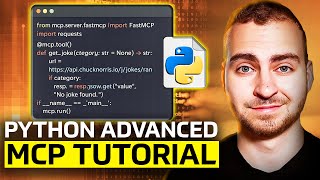
Build ANYTHING With an Advanced MCP Server (Python, Authentication, Databases & More)
Tech With Tim
70.5k views

This New AI Coding Platform Is Insane (Warp Tutorial)
Tech With Tim
91.0k views

Coding Will Never Be The Same... Trae AI Tutorial
Tech With Tim
60.9k views
Unlock all features
FREE: Get instant access to 10 AI summaries, chats, or transcripts per day.
Unlock all features
FREE: Get instant access to 10 AI summaries, chats, or transcripts per day.
Unlock all features
FREE: Get instant access to 10 AI summaries, chats, or transcripts per day.
Unlock all features
FREE: Get instant access to 10 AI summaries, chats, or transcripts per day.
Unlock all features
FREE: Get instant access to 10 AI summaries, chats, or transcripts per day.
Related videos
Build & Deploy a Python AI Agent in 20 Minutes
Tech With Tim
38.6k views
Build a Python AI Agent in 10 Minutes
Tech With Tim
84.2k views
How to Build AI Agents in Python
Tech With Tim
46.7k views
How to Build a Production-Ready RAG AI Agent in Python (Step-by-Step)
Tech With Tim
77.8k views
Python is Changing – Here’s What’s Coming
Tech With Tim
165.5k views
The Next Step After Learning Python Basics
Tech With Tim
107.8k views
Learn Pandas in 30 Minutes - Python Pandas Tutorial
Tech With Tim
166.6k views
Build ANYTHING With an Advanced MCP Server (Python, Authentication, Databases & More)
Tech With Tim
70.5k views
This New AI Coding Platform Is Insane (Warp Tutorial)
Tech With Tim
91.0k views
Coding Will Never Be The Same... Trae AI Tutorial
Tech With Tim
60.9k views
Top Comments (10)
Tim soft launching his arms in this video. I see you
My boy tim look like he just came for lifetime fitness 🤣
the “don't get too distracted” and the blinking is one of the most distracting things you've done haha, here's an old subscriber, I hope this video gets me like the first flask/apis videos you did
Thanks, this is interesting. Essentially this is about: 1. Interacting with an LLM ( using its capabilities as they are i.e you are not changing the core of the LLM) 2. Giving it a task ( prompt, query, request etc ..) 3. Giving it the data, tools, resources required to complete the task ( they all can come from multiple sources) 4. Specifying what to do with the output ( formatting it a certain way, saving it in a certain location, local or cloud etc...) 5. Specifying how often the task needs to be done. I am sure there are other elements, but that's what was the takeaway for me. Thank you for the introduction I look forward to learning more, particularly how to link functions to achieve a desired outcome (built-in and user defined functions) 🙏
Download PyCharm and use it for free forever with one month of Pro included: https://www.jetbrains.com/pycharm/
I really like how you barely explain the complex things related to MCP, but at the same time, you spend way more time explaining how to kill a process in Monit
Yo! You are redefining what a developer looks like! No more dude in a hoodie. All about the tank top! I love your videos and you have been a great help. Now let me help you with something. The three lined icon that represents a menu is called a "hamburger". OK my good deed of the day is done. Please keep doing what you are doing!
i was looking for tips in computer science major and i did not notice that the video was 5 years ago , when i click in the video i was like wtf this is the same guy hahaahahahahaha new follower
Nice video, sir. I was very confused about MCP and you explained it in so much easy way. Kudos to you
Amazing, Helping me so much on the way to integrate MCP onto my server. Thanks a bunch mate !
Unlock the Data Inside
Turn Videos into Knowledge
- Get FREE 10/day: transcripts, summaries, chats
- Chat with videos, export text & PDF
- $1 free API credit for RAG, chatbots & research
Free forever plan • All features unlocked
Top Comments (10)
Tim soft launching his arms in this video. I see you
My boy tim look like he just came for lifetime fitness 🤣
the “don't get too distracted” and the blinking is one of the most distracting things you've done haha, here's an old subscriber, I hope this video gets me like the first flask/apis videos you did
Thanks, this is interesting. Essentially this is about: 1. Interacting with an LLM ( using its capabilities as they are i.e you are not changing the core of the LLM) 2. Giving it a task ( prompt, query, request etc ..) 3. Giving it the data, tools, resources required to complete the task ( they all can come from multiple sources) 4. Specifying what to do with the output ( formatting it a certain way, saving it in a certain location, local or cloud etc...) 5. Specifying how often the task needs to be done. I am sure there are other elements, but that's what was the takeaway for me. Thank you for the introduction I look forward to learning more, particularly how to link functions to achieve a desired outcome (built-in and user defined functions) 🙏
Download PyCharm and use it for free forever with one month of Pro included: https://www.jetbrains.com/pycharm/
I really like how you barely explain the complex things related to MCP, but at the same time, you spend way more time explaining how to kill a process in Monit
Yo! You are redefining what a developer looks like! No more dude in a hoodie. All about the tank top! I love your videos and you have been a great help. Now let me help you with something. The three lined icon that represents a menu is called a "hamburger". OK my good deed of the day is done. Please keep doing what you are doing!
i was looking for tips in computer science major and i did not notice that the video was 5 years ago , when i click in the video i was like wtf this is the same guy hahaahahahahaha new follower
Nice video, sir. I was very confused about MCP and you explained it in so much easy way. Kudos to you
Amazing, Helping me so much on the way to integrate MCP onto my server. Thanks a bunch mate !