Unlearning Japanese - Real Real Japan #11

Related videos

Japanese vs. American 7-Eleven (Taste Test)
Good Mythical Morning
502.7k views

Unlearning Japanese - Real Real Japan #09
Real Real Japan
19.2k views

Unlearning Japanese - Real Real Japan #08
Real Real Japan
19.4k views

Unlearning Japanese - Real Real Japan #07
Real Real Japan
24.5k views

UAP hotspots: Are the US and Japan working together to research UAPs? | Reality Check
NewsNation
258.2k views
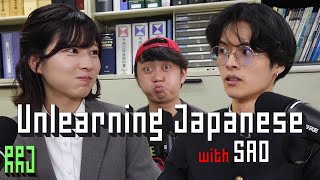
Unlearning Japanese with SAO - Real Real Japan #06
Real Real Japan
364.2k views

'Why is Japanese So Hard??' | Bar Sugi #3
Real Real Japan
28.1k views

"I Thought It Was Just Soap..." | Bar Sugi #2
Real Real Japan
46.6k views

Ken Ken Ken
Real Real Japan
18.6k views

Real Real Japan Live | Tokyo Comedy Bar
Real Real Japan
185.9k views
Analyzing Hiragana Structure, Ambiguity, and Phonetic Shifts
Discover the organizational logic behind Japanese Hiragana modules and identify specific phonetic patterns that often trip up new learners.
Short Summary
- Japanese syllabaries organize characters into distinct groups based on consonant families (K-line, S-line, etc.).
- Certain characters undergo mandatory pronunciation changes based on their grammatical function within a sentence.
- Mastering smoother Japanese speech requires understanding combination sounds and expanding core vocabulary.
This discussion unpacks the fundamental structure of Hiragana, focusing on why seemingly simple characters can behave unexpectedly due to context or grammatical role.
Unlock all features
FREE: Get instant access to 10 AI summaries, chats, or transcripts per day.
Unlock all features
FREE: Get instant access to 10 AI summaries, chats, or transcripts per day.
Unlock all features
FREE: Get instant access to 10 AI summaries, chats, or transcripts per day.
Unlock all features
FREE: Get instant access to 10 AI summaries, chats, or transcripts per day.
Unlock all features
FREE: Get instant access to 10 AI summaries, chats, or transcripts per day.
Related videos
Japanese vs. American 7-Eleven (Taste Test)
Good Mythical Morning
502.7k views
Unlearning Japanese - Real Real Japan #09
Real Real Japan
19.2k views
Unlearning Japanese - Real Real Japan #08
Real Real Japan
19.4k views
Unlearning Japanese - Real Real Japan #07
Real Real Japan
24.5k views
UAP hotspots: Are the US and Japan working together to research UAPs? | Reality Check
NewsNation
258.2k views
Unlearning Japanese with SAO - Real Real Japan #06
Real Real Japan
364.2k views
'Why is Japanese So Hard??' | Bar Sugi #3
Real Real Japan
28.1k views
"I Thought It Was Just Soap..." | Bar Sugi #2
Real Real Japan
46.6k views
Ken Ken Ken
Real Real Japan
18.6k views
Real Real Japan Live | Tokyo Comedy Bar
Real Real Japan
185.9k views
Top Comments (10)
I have memorized all the hiragana but I still need to learn katakana 😅
Sugi's English is in fact "many many improvement"
REALLY REALLY appreciate the on-screen subtitles
here's a basic summary of hiragana: a i u e o vowels: あいうえお k-line: かきくけこ s-line さしすせそ t-line: たちつてと n-line: なにぬねの h-line: はひふへほ m-line: まみむめも y-line: や ゆ よ r-line: らりるれろ w-line: わ を finally, n: ん (there's no vowel, it's just n) special cases: し isn't si, it's shi ち isn't ti, it's chi つ isn't tu, it's tsu ふ isn't hu, it's fu (however it's not an exact f sound, more of a mix between a gentle blow and an f sound, followed by an "u" sound へ is pronounced e when used as a particle (short grammatical word, this one is specifically the equivalent of the english word "to", as in "go *to* school") は is pronounced wa when used as a particle. を is pronounced as o in some dialects, here's why: in old Japanese, they used to have わ, ゐ, ゑ and を, being wa, wi, we and wo. but then there was a language change where they dropped the w from words. while わ was completely unaffected by the language change, but を only partially survived it. ゐ and ゑ were changed to i and e, though a bit after they were just swapped out for i and e, which is why they're used as wi and we are sometimes still wi and we instead of i and e. you can also use dakuten to make unvoiced sounds voiced. か (ka)→が (ga) k turns into g s → z t → d sh/ch → j ts → dz h/f → b u → vu there's also handakuten は (ha)→ぱ(pa) h/f → p you can also make や, ゆ and よ smaller (ゃ, ゅ andょ) and put them after sounds that end in i (き, し, ち, に etc.) to change the sound a bit み + ゃ = みゃ (mya) きゃ is a softer か, like in キャメロン し and ち don't turn into shya and chya, but rather sha and cha. つ can be small too, it lengthens the consonant sound of these guys かきくけこさしすせそたちつてと when going before them you can also lengthen vowel sounds by putting ー after them or the matching vowel letter, like ねえ, but you can also use い to lengthen e sounds and う to lengthen o sounds. hope this helps 😊
A video where Sugi roasts English language like this would be a massive hit
The whispering "mama" was funny for no reason
Need •not-why-memorize• and •same-same-but-different• stickers to glue them in a workbook😢😂
Sugi and Cameron have the most wonderful on screen chemistry; what an amazing friendship and channel you two created. Seriously, I look forward to every time I see a new video of y’alls in my feed 🍻 cheers to your continued success!
最近あなた方にハマってます。
I choked when Cameron said “brain damage” lmfao
Unlock the Data Inside
Turn Videos into Knowledge
- Get FREE 10/day: transcripts, summaries, chats
- Chat with videos, export text & PDF
- $1 free API credit for RAG, chatbots & research
Free forever plan • All features unlocked
Top Comments (10)
I have memorized all the hiragana but I still need to learn katakana 😅
Sugi's English is in fact "many many improvement"
REALLY REALLY appreciate the on-screen subtitles
here's a basic summary of hiragana: a i u e o vowels: あいうえお k-line: かきくけこ s-line さしすせそ t-line: たちつてと n-line: なにぬねの h-line: はひふへほ m-line: まみむめも y-line: や ゆ よ r-line: らりるれろ w-line: わ を finally, n: ん (there's no vowel, it's just n) special cases: し isn't si, it's shi ち isn't ti, it's chi つ isn't tu, it's tsu ふ isn't hu, it's fu (however it's not an exact f sound, more of a mix between a gentle blow and an f sound, followed by an "u" sound へ is pronounced e when used as a particle (short grammatical word, this one is specifically the equivalent of the english word "to", as in "go *to* school") は is pronounced wa when used as a particle. を is pronounced as o in some dialects, here's why: in old Japanese, they used to have わ, ゐ, ゑ and を, being wa, wi, we and wo. but then there was a language change where they dropped the w from words. while わ was completely unaffected by the language change, but を only partially survived it. ゐ and ゑ were changed to i and e, though a bit after they were just swapped out for i and e, which is why they're used as wi and we are sometimes still wi and we instead of i and e. you can also use dakuten to make unvoiced sounds voiced. か (ka)→が (ga) k turns into g s → z t → d sh/ch → j ts → dz h/f → b u → vu there's also handakuten は (ha)→ぱ(pa) h/f → p you can also make や, ゆ and よ smaller (ゃ, ゅ andょ) and put them after sounds that end in i (き, し, ち, に etc.) to change the sound a bit み + ゃ = みゃ (mya) きゃ is a softer か, like in キャメロン し and ち don't turn into shya and chya, but rather sha and cha. つ can be small too, it lengthens the consonant sound of these guys かきくけこさしすせそたちつてと when going before them you can also lengthen vowel sounds by putting ー after them or the matching vowel letter, like ねえ, but you can also use い to lengthen e sounds and う to lengthen o sounds. hope this helps 😊
A video where Sugi roasts English language like this would be a massive hit
The whispering "mama" was funny for no reason
Need •not-why-memorize• and •same-same-but-different• stickers to glue them in a workbook😢😂
Sugi and Cameron have the most wonderful on screen chemistry; what an amazing friendship and channel you two created. Seriously, I look forward to every time I see a new video of y’alls in my feed 🍻 cheers to your continued success!
最近あなた方にハマってます。
I choked when Cameron said “brain damage” lmfao